

CPTu and Vane Test
When a project needs more detail than conventional boring delivers, CPTu and the vane test measure soil behavior in real time, with no wait for lab results. They are the right tool to predict settlement, pile and foundation bearing capacity, and risk in soft clay soils before the foundation is decided.

What we deliver
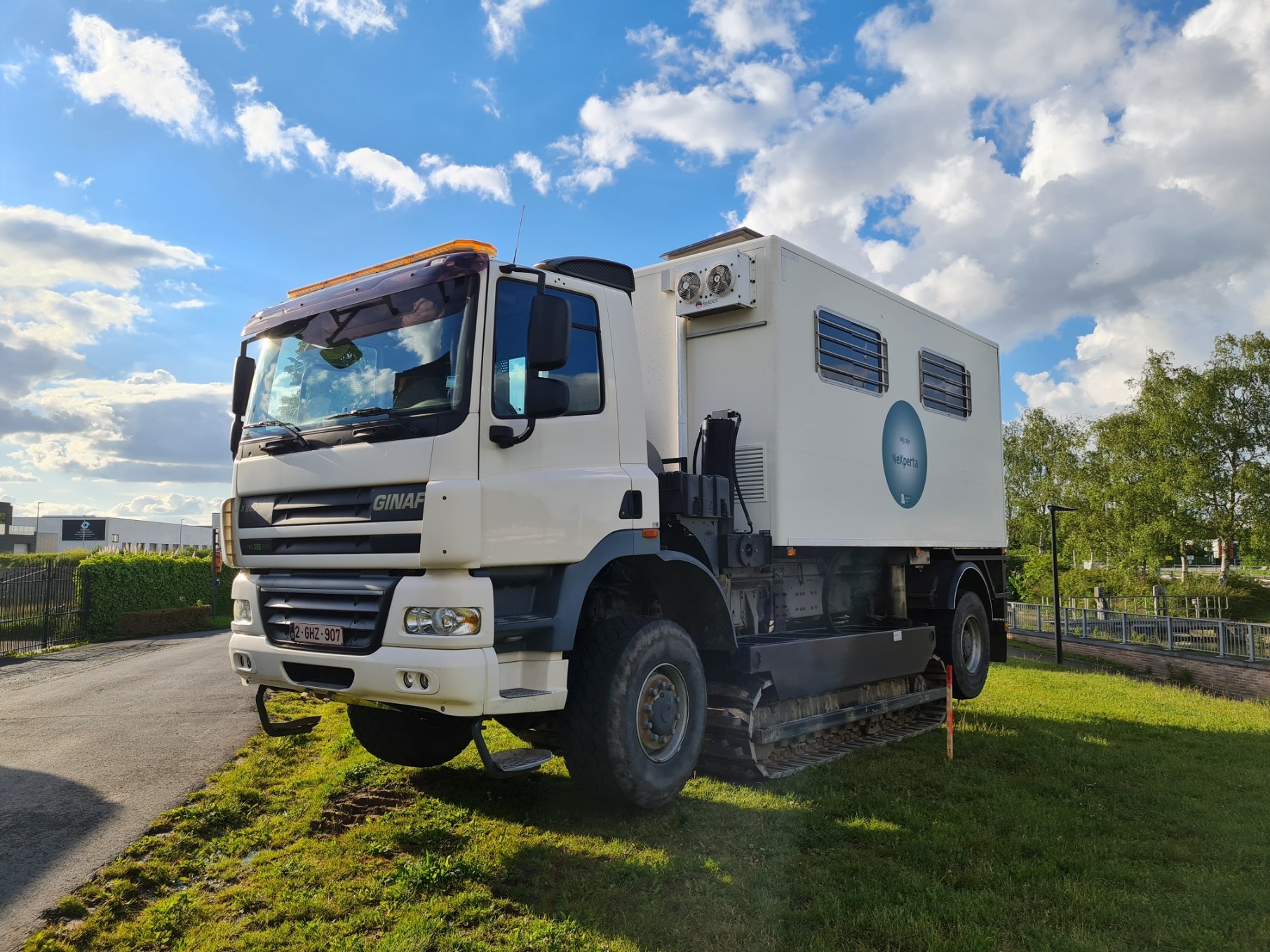
The CPTu (piezocone) pushes an instrumented cone into the soil at a constant rate of 2 cm/s, continuously recording tip resistance (qc), sleeve friction (fs) and pore pressure (u2). The dissipation test -- a temporary pause in advance to monitor the decay of excess pore pressure -- estimates the horizontal coefficient of consolidation (Ch) and the water table position. That near-continuous profile detects thin sand and clay lenses that a discrete boring can miss, and supports correlations for stratigraphy, strength, compressibility and the bearing capacity of piles and shallow foundations.
The vane test complements the CPTu in saturated clays: a four-bladed cruciform vane is rotated in the soil at 0.1°/s, and the maximum measured torque is converted into the peak undrained shear strength (Su); the vane is then rotated rapidly to remould the surrounding soil and measured again, giving the residual strength (Sur) and the clay's sensitivity (St = Su/Sur).
Services
- CPTu test (piezocone CPT) — qc, fs and pore pressure u2
- Dissipation test for the horizontal coefficient of consolidation (Ch)
- Vane test (field vane shear test) — torque × rotation, Su, Sur and sensitivity
Measured parameters
The CPTu continuously records qc, fs and u2; the dissipation test adds Ch. The vane test measures Su, Sur and the clay's sensitivity St.
| Parameter | Symbol | Unit |
|---|---|---|
| Cone tip resistance | qc | MPa |
| Sleeve friction | fs | MPa |
| Pore pressure (usual position, behind the cone) | u2 | kPa |
| Horizontal coefficient of consolidation (via dissipation test) | Ch | cm²/s |
| Peak undrained shear strength (vane test) | Su | kPa |
| Residual (remoulded) undrained shear strength | Sur | kPa |
| Clay sensitivity (St = Su / Sur) | St | dimensionless |
What the test lets you determine
- Detailed subsurface stratigraphy
- Detection of thin sand and clay lenses
- Prediction of soil strength and compressibility
- Coefficient of consolidation and permeability of fine-grained soils
- Bearing capacity of piles and shallow foundations
Technical standards
CPTu and the vane test follow international standards and the Brazilian national reference.
| Title | Code |
|---|---|
| Standard Test Method for Electronic Friction Cone and Piezocone Penetration Testing of Soils | ASTM D5778 |
| Geotechnical investigation and testing — Field testing — Electrical cone and piezocone penetration test | ISO 22476-1:2022 |
| Standard Test Method for Field Vane Shear Test in Saturated Fine-Grained Soils | ASTM D2573 / D2573M-18 |
| Geotechnical investigation and testing — Field testing — Field vane test | ISO 22476-9 |
| Brazilian standard for the vane test (national reference) | ABNT NBR 10905 |
Limitations
We publish where the method has limits -- that is how you recognize whoever masters the technique.
- The CPTu does not recover a physical sample -- design parameters depend on empirical correlations.
- CPTu penetration is limited in gravel, boulder or rock layers (mechanical refusal).
- The vane test is unsuitable in soils with sand, silt or fibrous inclusions, which break the shear surface unevenly.
- The strength measured by the vane test depends on the rotation rate and is anisotropic -- a direct reading of Su may require the Bjerrum correction before use in design.
Need a detailed subsurface profile?
Talk to GEOSEA and get a CPTu and vane test proposal tailored to your project.
Talk to GEOSEA